

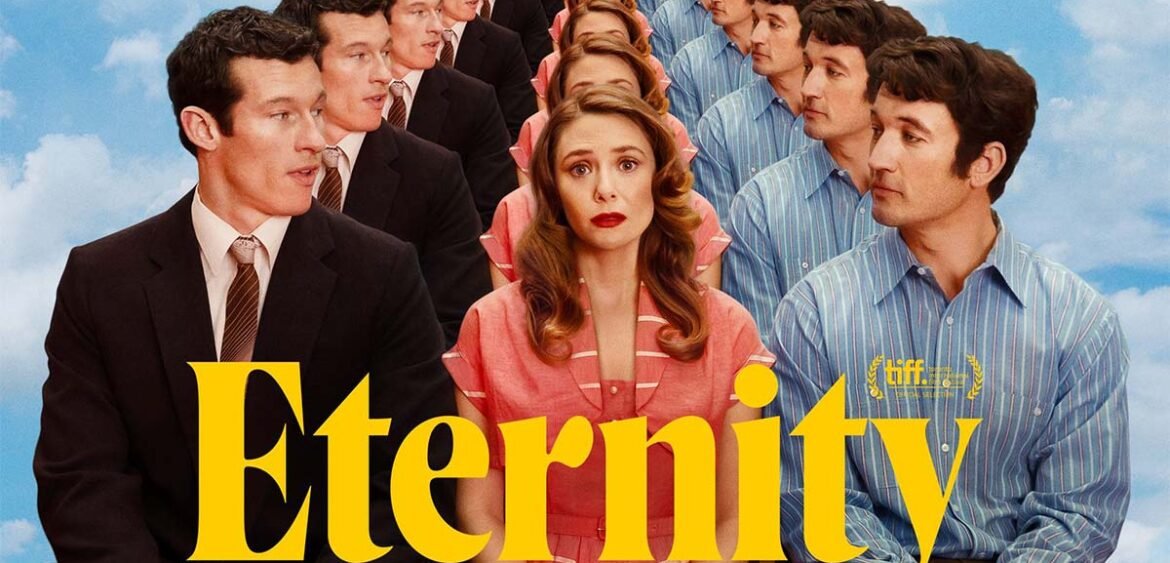

There are some movies that ask you to suspend your disbelief. And then there is Eternity—a film that invites you to contemplate the afterlife, the infinite possibilities of love, and the rather inconvenient possibility that even eternity might require a little planning.
Because if there’s one thing that can make the prospect of living forever seem daunting, it’s the realization that you’ll still have to make decisions. Big decisions. Romantic decisions. Possibly even decisions about where to live, what your surroundings should look like, and whether you’ve made the right choice. Apparently, not even death gets you out of that.
But the magic of Eternity is that it takes these wonderfully absurd possibilities and makes them feel deeply human. Beneath the wit, imagination, and fantasy lies something familiar: our longing to belong, our complicated relationships with love, and our desire to find a place in the world—whether that world lasts eighty years or forever.
Bringing a film like this to life is an extraordinary undertaking. It takes imagination, courage, collaboration, and a whole lot of talented people who are willing to make the impossible look perfectly natural.
A special thank you and congratulations to Zazu Meyers for this Directors Guild of Canada nomination. Her creative talents as production designer helped give Eternity its visual identity. Production design is one of those magical filmmaking disciplines that audiences may not consciously notice when it works beautifully. They simply believe in the world they are seeing. Every space, every detail, every visual decision helps tell the story, establishing a sense of place and possibility that makes the extraordinary feel tangible. Zazu’s creative vision gives the film a world with character, atmosphere, and a personality all its own.
Of course, no production designer works in isolation. Behind every beautiful set and carefully considered detail is an art department full of people whose talent, patience, ingenuity, and hard work transform ideas into reality.
I want to offer my warmest thanks to my exceptionally talented art department team: Wenke Li, Jessica Lehtola, Melanie Viger, Sara Borowski, Lisa Canzi, Michael Erickson, and Sunil Pant. Thank you also to our incredibly resourceful Set Decorator Janessa Hitsman and her team, as well as to our amazing Construction and Paint Departments.
Your contributions were an essential part of the creative process. The art department is where imagination meets practical reality—where sketches become spaces, concepts become objects, and the tiniest details somehow become everyone’s responsibility five minutes before they need to be finished. You all helped make the world of Eternity richer, more believable, and more alive. I’m grateful for your talent, your dedication, and the care you brought to the work.
I also want to acknowledge some of the people who helped make this journey so memorable.
First, a heartfelt thank-you to A24 for its support of Eternity. A24 has earned a reputation for championing distinctive filmmaking and giving original ideas room to breathe. In an industry where playing it safe can sometimes feel like the safest way to lose your imagination, that kind of support matters enormously. Thank you for believing in the project and helping bring this wonderfully unconventional story to the screen.
My sincere thanks also go to Trevor White of Star Thrower Entertainment and Michael Williams. The contributions of producers often involve solving problems that the rest of us never knew existed, anticipating problems that haven’t happened yet, and somehow making the whole enterprise appear as though it was always going according to plan. It rarely is. Their support, commitment, and work behind the scenes helped make this ambitious undertaking possible, and I’m deeply grateful to them both.
Then there is David Freyne, whose inspiring direction gave Eternity its distinctive spirit. Balancing comedy, romance, fantasy, and genuine emotional resonance is no small feat. Lean too far in one direction and you lose the heart; lean too far in another and you risk losing the fun. David brought imagination and sensitivity to that balancing act, allowing the film to explore its big questions without forgetting that sometimes the most profound truths arrive disguised as a very good joke.
What makes filmmaking so rewarding is that, for all its technology, logistics, budgets, schedules, and occasionally heroic quantities of coffee, it remains a profoundly human enterprise. A film is never simply the product of one person’s vision. It is the accumulated imagination of many people, each contributing something that no one else could quite bring in the same way.
Here’s to Eternity, to the people who made it possible, and to the extraordinary things that happen when imagination, collaboration, and a little bit of movie magic come together.



Recent Comments